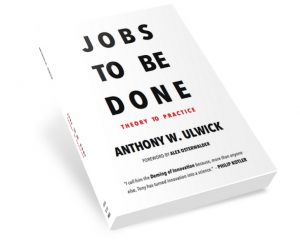
Tony Ulwick is a pioneer in job-to-be done theory and practice and the author of the book “Jobs To Be Done”

Tony Ulwick
 By Stephen Shaw
The legendary Harvard Marketing Professor Theordore Levitt is widely credited with saying, “People don’t want a quarter inch drill, they want a quarter inch hole”.
Except he never came up with that saying himself. In his 1969 book “The Marketing Mode” he was actually quoting an obscure New York ad executive by the name of Leo McGivena. Even McGivena may not have come up with it. It’s possible he may have cribbed it from a 1942 newspaper insurance ad that appeared in a Pennsylvania newspaper. The ad copy read in part: “Hardware stores report that over one million men bought one-quarter inch drills in one year. Not one of those million men wanted the drills. They wanted quarter inch holes in metal or wood.” However, Levitt did add this pithy adage of his own: “People don’t buy products; they buy the expectation of benefits.”
Whoever deserves full credit, the saying is as true now as it was then: when people buy a product, they are looking to solve a problem and satisfy a need. But here’s the mystery: if most marketers acknowledge the wisdom of that saying, why is innovation still largely a hit-or-miss proposition for most companies (mostly miss)? Depending on the industry, the product failure rate is something like 75-90%. And that record of futility has barely budged in the decades since Levitt immortalized that saying.
 Think how many thousands of new products hit the market every year and the huge amount of R&D money behind it. Think of the time and effort to nurse those product concepts through every phase of the stage-gate proceShaw: the money spent on market research – on engineering design – on prototyping and testing – on business case development – on product launches. Companies plow stubbornly ahead relying on the flimsiest signals, thinking they know what the customer wants, when really they don’t. The high-level “needs statements” they extract from segmentation models and personas are often vague, generalized, and subject to misinterpretation. When those new products eventually make their way off the factory floor, they are usually met with a collective yawn or outright rejection by the marketplace.
A solution to this game of chance began to take shape in the early 1990s when Tony Ulwick, who had founded an innovation consulting firm after a decade of observing product flops at IBM, invented a patentable process he called “Outcome-Driven Innovation” (ODI). His idea, in short, was that customers “hire” products to perform specific jobs in their lives. What marketers needed, he believed, was a failsafe way of matching those jobs to the right solution. Taking his cue from Six Sigma principles, he came up with a systematic process for identifying and prioritizing desired job outcomes based on a rigorous analysis of customer needs (read “jobs”). In 2003 he codified his process in a book titled “What Customers Want”, arguing that marketers can take the guesswork out of innovation by adopting his method of filtering and ranking potential opportunities through the eyes of the customer.
Around that same time the famed Harvard Business School professor Clayton Christensen, renowned for his theory of “disruptive innovation”, published a book called “The Innovator’s Solution” in which he introduces his own “jobs-to-be done” theory as a companion to his “disruption thesis”, recommending that businesses focus their innovation efforts on identifying jobs customers can’t get done due to a lack of available solutions.
By that point Tony Ulwick had already spent a decade or so helping businesses transform their innovation processes and dramatically reducing their new product failure rates. Today his starting point is to convince companies that they can achieve a sustainable competitive edge by segmenting their market around unmet or underserved customer needs. The trick is to define a need as a job that needs to be done with multiple desired outcomes that can be measured, scored and ranked. Doing so makes the innovation process far less risky and much more predictable.
Stephen Shaw (SS): You worked on IBM’s PCjr in the 1980s. Why did that product fail so spectacularly?
Tony Ulwick (TU): PC Junior was supposed to take over home computing and put IBM on the map in the consumer space. Instead, the day after it was introduced, the headlines in the Wall Street Journal read, “The PC Junior is a flop”. And of course we didn’t believe it. We thought, they don’t get it. Unfortunately, we didn’t get it. They had it right. It was a billion dollar failure. I asked the same question you asked: Why did it fail? What happened? I started looking around IBM to figure out what research went into this, how’s the process work. And I quickly realized there wasn’t really a process. It was a pure technology push. And that still happens today, all the time. Why do products fail? They fail to meet a customer need. That’s it, the top reason. And from that point on, I just said there’s got to be a better way. So I got very interested in trying to create a process that mitigates the risk.
SHAW: How did you come up with your eventual solution?
ULWICK: With innovation, you’re just trying to come up with a solution that addresses an unmet need. What I learned pretty quickly is a lot of companies take what I call “the ideas first” approach to innovation, where they don’t know all the needs, but they have an idea and they start building it, prototyping it, putting it in front of customers to get feedback and then going through an iterative development process. They use names like “pivoting” and “failing fast” and that kind of thing, as if that makes any difference, because it still leads to high failure rates.
Other companies take a “needs first” approach to innovation: Let’s get out in front of customers, understand what their needs are, understand which are unmet, and then we’ll solve those needs. But that doesn’t work well either. Because what I discovered is that in nearly every product team there’s disagreement on what a need even is. If you go to the sales team, they talk about needs as features and benefits; marketing talks about them as “exciters” and “delighters”; development talks about them as specs and requirements. There’s 40 different terms I routinely hear from people describing what a need is. That’s really where the problem lies: We can’t even agree on what a need is, never mind which are unmet and what the best solution is.
So, this goes back to Levitt’s famous quote, “people don’t want the quarter inch drill – they want the quarter inch hole”. Instead of studying the product, the drill, let’s study the process. What are people trying to accomplish? Let’s define needs around what they’re trying to do. So this became known as “jobs to be done” theory: people “hire” products to get a job done, so let’s study the job – make the job the unit of analysis and figure out how people measure success along each step of the way. And those metrics are the customer’s needs. That’s what a need is.
SHAW: As a process engineer yourself, did you take your inspiration from Six Sigma?
ULWICK: Absolutely I did: Six Sigma uses process control to reduce variability, to reduce defects. And I thought, well, people are trying to do the same thing, get a job done faster, more predictably, no defects. And so I just took that same thinking and came up with “outcome driven innovation”.
SHAW: When you started your consultancy, which you initially called the “Total Quality Group”, what was your vision? How far had your thinking evolved around the need to focus on outcomes and not products?
ULWICK: It was clear right from the start because the metrics were tied to what people are doing while they’re trying to execute a job. What was less clear was how to prioritize them. But it was clear in my head that we needed to follow a process where we could identify the customer, what their needs are, their outcomes, and we could figure out which are unmet. We could see if there’s segments of people with different unmet needs and then decide what we want to do.
So all of that was pretty clear. But making it happen and filling in all the gaps and all the steps, that’s taken years. I mean, we still make modifications to this day to execute on that. But the key is the different mindset. People buy products to get a job done. Let’s study the job to be done, not the product. And for a lot of people it’s hard to stay out of the solution space. So it requires a different mindset and discipline. That’s why people still to this day follow an “ideas first” approach to innovation, why they struggle to define needs and still struggle with innovation. It’s not as if the problem’s been widely solved.
SHAW: Your “aha” moment was coming up with the “jobs to be done” framework. Which takes me to a question around your relationship with Clayton Christensen, who you met in 1999, after developing your ODI framework. How much did you influence his landmark book in 2003, “The Innovator’s Solution”, which is the same year you came out with your book “What Customers Want”?
ULWICK: When I talked to Clay in 1999, I felt like I had a solution for the “innovator’s dilemma”. At that point, ODI was working very effectively in many companies. He was a very kind, gracious gentleman. We sat down and talked, and I think I did have some influence on his thinking. In his book he referenced “Outcome Driven Innovation”. So, I was thrilled that he picked that up and talked about it.
SHAW: One of the things you say in your first book is – and I love this phrase – “Companies may not have the time to get innovation right, but they have the time to do it over”. Do they not have the time or it’s simply they don’t take the time?
ULWICK: Well, they don’t take the time. Or they perceive they don’t have the time, but they try to make up for it on the back end. But they’re wasting time going through iteration after iteration. When people adopt ODI, they cut their development time by up to 75%. But I think the real problem is companies don’t budget for the type of market research that’s needed to make this effective. They’re anxious to take action. If you look at the venture capital space, they’re betting on ideas and management teams, not on well vetted out product concepts. They’re just assuming that with the right team and the right idea, they’ll figure it out: they know 10% of the ideas will win, so they’ll make a lot of money, that’s good enough for them.
SHAW: Companies really struggle to even define what their target market is, never mind what the underserved needs of customers are. Which suggests to me that the starting point should be, “What market are we serving?”.
ULWICK: Yeah, you’re absolutely right. Today I spend more and more time thinking about how to define the market. Because what I learned is, not only do people not agree on what a need is, they don’t agree on what a market is. Should we define a market around a technology, a product, a vertical, a use case, a persona, a geography, a vertical, I could go on. Who’s the group of people that you want to target and create value for and what job are they trying to get done? So defining a market as a group of people and a job to be done is very different.
A lot of companies prematurely segment their market. When we define a market we try to make the group of people as broad as possible. Let’s include everyone who’s trying to get the job done, not just some of the people who are trying to get the job done – that would be a segment. So what we do is after we’ve defined the broad market, know the needs, know which are unmet, then we segment around the unmet needs, and then we can find segments who may be underserved or overserved in different ways.
SHAW: The other thing I like about your approach is you’re not just thinking about what the product is doing when it’s in use, you’re thinking about the entire lifecycle.
ULWICK: Yeah, you’re absolutely right. You know, people buy a product to get a job done, but you still have to satisfy as a manufacturer all of the consumption chain jobs. It’s going to be purchased and delivered and set up and interfaced with and cleaned and maintained and stored and upgraded. To your point, we need to understand all the needs associated with the product lifecycle. Before that though, you have to conceptualize the product, what’s it going to do. Then you hand it off to development. Development has to create it in such a way that it’s easy to interface with and store and maintain and upgrade and all those types of things.
SHAW: What is the biggest mistake companies make today in innovation?
ULWICK: Discovering what the unmet needs are and everyone agreeing to it. That’s what’s broken. Because as it stands right now, people don’t agree on what a need is, they don’t agree on what the needs are, they don’t agree on what needs are unmet, they don’t even agree on what segments exist. So they use proxies like demographics and psychographics. And that’s the problem. It’s just that simple. If you can’t get your entire team to agree on what the need is, then you run the risk of failure. And that’s the root cause of failure.
SHAW: You’re quite dismissive of need segmentation as a tool for identifying needs. Can you explain what your issues are with it?
ULWICK: It’s not based on needs, that’s the problem. I learned this at IBM back in the 1980s. We were working with McKinsey at the time and they did a needs based segmentation study which failed miserably. It’s not that I’m against needs based segmentation – I’m just for needs based segmentation that uses outcomes as need statements. You’re segmenting around where people struggle to get the job done and you can figure out quite simply where they’re underserved, overserved, and that forms a basis for very effective “outcome based segmentation”, just to differentiate.
SHAW: Can you provide an overview of your ODI process?
ULWICK: It begins with defining the market. And the market is a group of people trying to get a job done. We’re defining the job as a process they’re trying to execute. So as an example it could be cardiologists trying to restore blood flow in an artery. I wrote an article in HBR back in 2008 called, “The Customer Centered Innovation Map” (1) that talks about job mapping. So it’s the first thing we do after we define what the job is. We sit with customers and have them take us through the key steps in the job. What are they trying to do? Now, this is not a process map. We’re not laying out what people are doing in the solution space where there might be 20 solutions being executed in 20 different ways. Because we don’t want 20 process maps. We just want one job map that reflects what everyone’s trying to accomplish.
Once we create the job map, we look at each step in the job and collect the outcomes. So we sit with customers and ask them to take us through the execution of the job, just step by step, how they measure success along the way. So go back to the cardiologist trying to restore blood flow in an artery. They want to minimize the likelihood of breaking into a side vessel, or minimize the time it takes to maneuver through a tortuous vessel, or minimize the time it takes to reach the lesion. They have very specific measures they’re using to judge success in restoring blood flow to the artery. So you spend hours with customers learning how they measure success when getting a job done. These are the metrics they’re using to judge what value is. So we want to collect these statements from their perspective. Then we prioritize them.
SHAW: My understanding is that you typically come up with somewhere between 50 and 150 different outcomes as a result of those interviews.
ULWICK: That’s right. It’s not as if there’s 5, or 10, or 20 needs. There’s 100 or more needs. And you have to understand what all those needs are before you can take the next step, which is to figure out which of those are unmet. So we rely on quantitative research. We send a survey to whoever the target customer is. And we ask them to tell us the importance of each outcome and their current level of satisfaction using whatever product they’ve chosen. We walk away from that exercise with a couple of data points for each outcome that we plot out on what we call the “opportunity landscape”. And that helps us figure out which of the outcomes are most important and least satisfied. Then we put them through an algorithm called the “opportunity algorithm”: the importance score plus a “importance minus satisfaction” score. What that tells us is the outcome has to be very important and the gap between importance and satisfaction has to be great before we call it unmet. Simple formula – works well. With that information, we now know where the market’s underserved or overserved.
But we don’t rely on that view, or that set of insights to take action. We take one more step first, which is to segment the market. Because we ask the question, do people agree on which needs are unmet? No, people don’t always agree on which needs are unmet. We’ve run thousands of studies, and it’s true in nearly every case. So what we do is we segment around the unmet needs – we run factor analysis, then cluster analysis. And what that creates are groups of people, segments, that have different unmet needs. It’s not demographics, psychographics, attitudes, behaviours, which companies often use as proxies for unmet needs, and then assume the result is a group of people with different unmet needs. Bad assumption. Because that’s usually not the case. The way to get it right consistently is to segment directly around the unmet needs. And from there you can find segments that are underserved, where people might be willing to pay more to get the job done better. You may find a segment that’s pretty well satisfied but has maybe one or two unmet needs, where you could run a sustaining strategy. You may find a segment that’s highly overserved, which could be a target for a disruptive strategy.
SHAW: Can you share an example?
ULWICK: Take surgeons trying to remove an anatomical structure. The segment that was overserved were patients who were younger, had no comorbidities, were not obese, didn’t have adhesions from previous surgeries. So trying to remove the anatomical structure was not hard. They’re overserving the market with today’s solutions. On the other extreme, you have patients who are older with multiple comorbidities. They might be obese, have adhesions from previous surgeries – makes it much harder to get the job done – highly underserved, willing to pay more to get the job done better in that situation. Same job, same set of outcomes, different circumstances cause them to have different unmet needs resulting in those segments.
That’s why I rely so heavily on segmentation because getting it right will guide the action you’re going to take. In other words, the type of opportunity dictates what strategy you should follow. If there’s an overserved segment, you should pursue a disruptive strategy. Companies say we want to disrupt the market. Okay, is there an overserved segment? Nope, you can’t do that. That would not work. But what you could do is go after that highly underserved segment and pursue a differentiated strategy and charge more. Or maybe you just get the job done better and charge less and pursue a dominant strategy or blue ocean strategy.
SHAW: What is the difference between a core functional job and an emotional job?
ULWICK: So you appeal to customers functionally and emotionally. The core functional job is the reason people are buying the product. We generally use the emotional jobs as a way to position the product. There’s one other type of job that we typically put in the studies as well that we call related jobs. Now, these are jobs that people try to get done in conjunction with, or maybe before or after getting the core job done. And we like looking at that because if you can create a product that gets multiple jobs done, that product’s generally more valuable to people than the product that only gets one job done.
SHAW: Another distinction you make is the difference between outcome based segmentation and job based segmentation.
ULWICK: There are situations where a company may be trying to figure out which new markets they want to be in. So this becomes more of a market selection exercise. We’ll do what we call a job study. We’ve done this for P&G, for example. We talk to customers and there’s 40, 50, 80 jobs. And so the question is, which one should they create products for? So we take all those jobs, run it through the same algorithm, we talk to customers, what’s important, what’s poorly satisfied, and we try to find jobs that are underserved.
In job based segmentation, we look for clusters of jobs that are underserved. So for example, we worked with Chiquita Brand International on snacks and they were asking, what other kind of snacks can we make besides bananas? And we looked at all the jobs people are trying to get done with snacks and there were I think 100 plus. We did our segmentation technique like I described, and we found a segment of the population, maybe 10% of the market, that were very underserved, that were trying to find a snack they could eat at night that would help them get to sleep. So there were five or six jobs related to that.
Now there’s over 10,000 varietals of bananas. One of the interesting debates was, should they come up with a nighttime banana? Bananas naturally have tryptophan in them, which is the same chemical that puts you to sleep after you’ve had a big turkey dinner. But they chose not to go down that path because bananas are seen as a morning food, an energy food. So they were very hesitant to go in that direction. Yet that would have been a brand new market for them.
SHAW: Can ODI apply to existing products? Because you make the point that value migrates. New needs will emerge over time.
ULWICK: Yeah, it works exactly the same for both because we’re not focused on the product, we’re focused on the job, remember? So whether it’s a new job or an existing job, doesn’t matter. It’s the same exact process. There’s really no difference. Companies have an existing product which they’re about to release, and they come to us and say, can you just make sure this is the right feature set? So the way we do that is we reverse engineer the features into outcome statements. What outcomes did the features help you address? There might be five features, each one addressing three outcomes. So there might be 15 outcomes that we’ll quickly put in the survey, figure out if any of them are important, unsatisfied, and then we can look at it and say, you know, four of these five features are addressing needs but the fifth one really doesn’t. So when you’re doing your marketing, make sure you emphasize the four that really matter.
For example, with Coloplast, the wound care company, nurses treat wound patients that are hospitalized. We found that 10 of the top 15 unmet needs had nothing to do with making the wound heal faster, which is the way everyone was positioning their products. It had to do with not making the wound get worse. The nurses were very afraid of it going downhill. So Coloplast changed their positioning from “fastest” to “we prevent complications”. And they got double digit growth within six months by repositioning their product.
When we helped Bosch enter the North American circular saw market, we pointed them to this segment that had 14 unmet needs. It took them three hours to come up with a new circular saw concept. And they said, Tony, it’s not as if we hadn’t thought about these ideas before: the problem is we thought about thousands of ideas and we didn’t know these were the 14 that create the most value for the customer.
SHAW: Do companies need two different development processes – one for improving existing products and one for creating new ones?
ULWICK: No, you can still use the same development process. The market you’re already in is the core market. If you want to go in a new market, what we say is go after your adjacencies first. Now, what’s adjacent to core? What other related jobs is the customer trying to get done? Or we may ask, “Who else is trying to get this job done?”. Either you have a technical capability to deliver on what the customer is trying to get done, or you have a relationship with the customer that you’re trying to evolve. So those are lower risk new markets versus what I consider a new market which is a new job. There you have to develop new capabilities. So that’s a much higher risk.
SHAW: I can’t quite understand why most companies haven’t fully adopted your approach to innovation. What’s the pushback you get?
ULWICK: Companies still like to rely on their intuition and their knowledge. And of course, bringing our process into a company can challenge the authority of people in the company. I can recall market research teams that worked very hard to derail the projects that we worked on. But I think most companies are just impatient.
1 – Harvard Business Review, “The Customer Centered Innovation Map”, May 2008
Stephen Shaw is the Chief Strategy Officer of Kenna, a marketing solutions provider specializing in delivering a more unified customer experience. He is also the host of the Customer First Thinking podcast. Stephen can be reached via e-mail at sshaw@kenna.
Related Posts